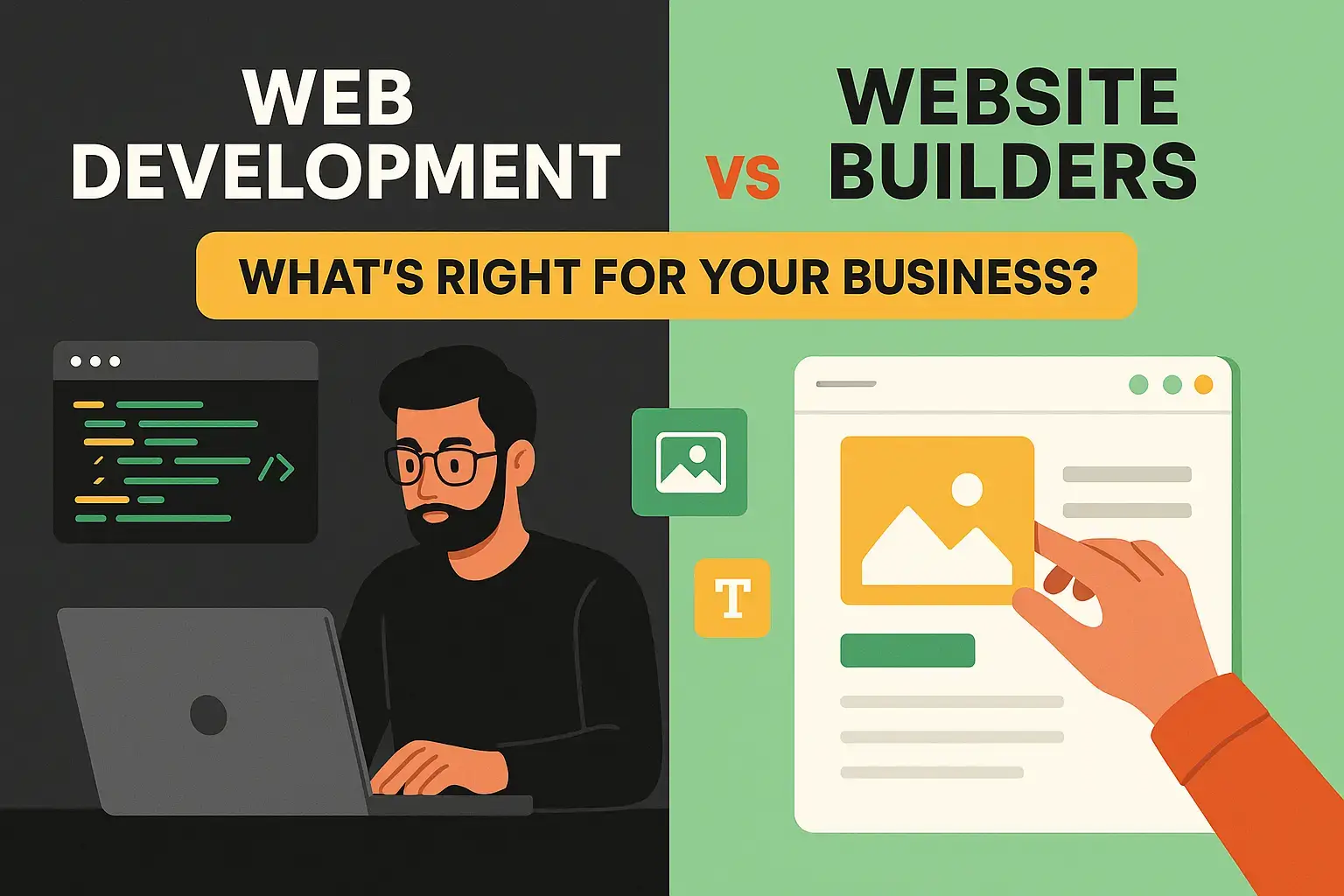
Custom Web Development vs Website Builders: Which to Pick
Starting an online presence for your business in 2026 is exciting, but the landscape has changed. With AI-driven search and stricter Google performance standards, choosing the right foundation is critical. Should you use a drag-and-drop tool, or invest in custom web development?
If you’re an entrepreneur or a small business owner, the simplicity of builders is tempting. However, understanding website builder limitations versus custom website benefits is the difference between a site that just exists and one that actually converts.
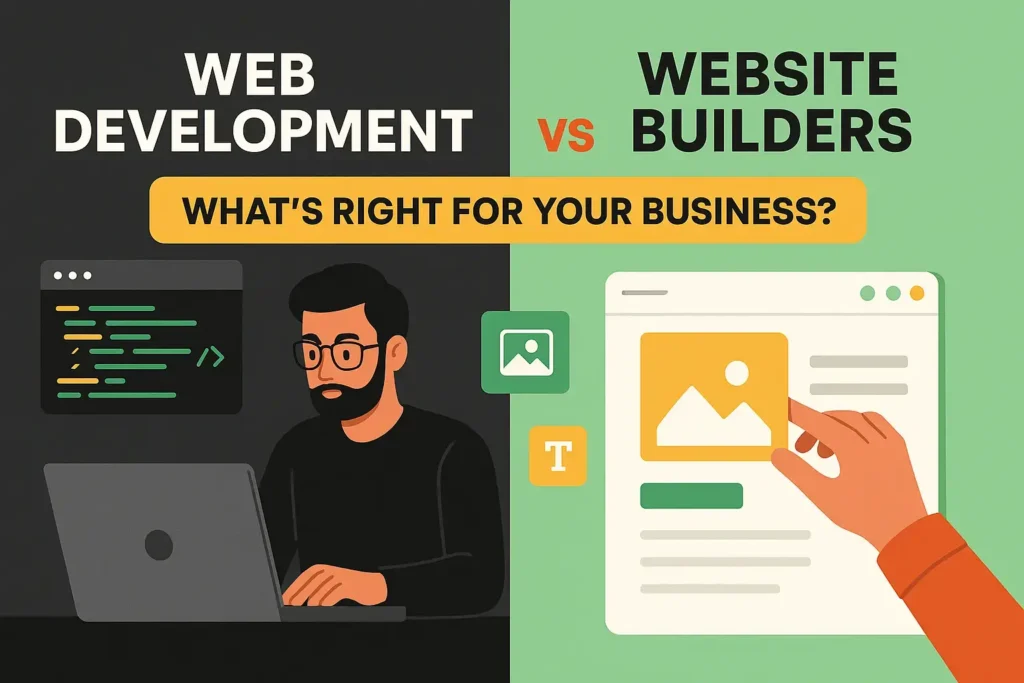
Website Builders: Easy but Limited
Platforms like Wix, Shopify, Squarespace, and Weebly remain popular for their “No-Code” promise.
Pros
- Zero Coding: Perfect for absolute beginners.
- Rapid Deployment: Go live in hours.
- All-in-One Hosting: Security and hosting are managed for you.
Cons
- Performance Bottlenecks: Code bloat hurts rankings.
- Limited Customization: Confined to platform ecosystem.
- Hidden Costs: Premium apps and fees add up quickly.
Monitor key performance metrics closely by following official Core Web Vitals guidelines.
Refer to the official Next.js documentation to learn advanced routing and rendering techniques.
Custom Web Development: High-Performance Authority
For brands that need to demonstrate maximum Expertise and Trust (E-E-A-T), custom development is the gold standard.
Pros
- Optimized Performance: Passes Core Web Vitals effortlessly.
- Total Scalability: Add complex custom API integrations.
- Full Ownership: You own every single line of code.
Cons
- Higher Investment: Larger upfront budget required.
- Development Time: It’s a marathon, not a sprint.
The 2026 Winner: The Hybrid Approach
In today’s market, most successful businesses choose a middle ground: WordPress + Advanced Page Builders (like Elementor or Bricks). This offers the best of both worlds.
- Ownership: Unlike Shopify or Wix, you own your WordPress data completely.
- SEO Superiority: Deeper control over technical metadata and schema markup.
- Cost-Effective: Get high-end functionality without expensive ground-up build budgets.
The Verdict: Feature Comparison
| Feature | Website Builders | Custom / Hybrid |
|---|---|---|
| Speed | Average to Slow | Fast / Optimized |
| SEO Control | Basic | Advanced |
| Ownership | Renting (Leased) | Full Ownership |
| Scalability | Low | High |
Choose a Website Builder If:
- You need a landing page or simple hobby site immediately.
- Technical SEO and long-term scaling aren’t priorities.
Choose Custom/Hybrid Development If:
- You are building a long-term brand that needs to rank on Google.
- You want fast load times and unique custom UX.
- You want to avoid growth limitations of closed builders.
Unlock Your Website’s Full Potential
- •New Look, Better Results: Professional Website Redesign 2026 Strategy Guide.
- •Zero-Budget Growth: How to Increase Website Traffic Without Ads.
- •Next-Gen Tech: Top Web Development Frameworks to Use in 2026.
Final Verdict: Move Beyond Generic Templates
In 2026, a “generic” look is a trust-killer. To rank and convert, your site needs to be fast, functional, and uniquely yours. Ditch the restrictive templates of Wix and Shopify for a solution that grows with you.
I specialize in building fast, scalable custom Next.js websites for modern brands.
We also create fully optimized and user-friendly WordPress websites tailored to your needs.
Discover why custom development for small businesses outperforms rigid template solutions.
Frequently Asked Questions
Clear answers to common questions about this topic.
Is Shopify or WordPress better for SEO in 2026?
WordPress provides deeper technical schema control and custom code optimization, while Shopify relies heavily on third-party apps.
What are the biggest website builder limitations?
Code bloat affecting Core Web Vitals, closed ecosystems, lack of database scalability, and subscription lock-in.
Why should I invest in professional web design services?
Professional development aligns site UX with search intent, maximizes page speed, and builds brand trust that drives higher conversion rates.